Yiddish Translations

Half-Voll Attempts

Good enough translations to get you started.

Every poem here appears four ways at once—the Yiddish original, a YIVO transliteration, an English translation, and a German one—so you can read across the columns and start sounding out the original yourself.

The translations are scaffolding, not authority. Where English drops something the Yiddish was carrying, the reader marks the word and tells you what went missing.

Explore the Collection
The Voices

Two Writers, One Vanishing Tongue

It begins with two figures of Yiddish modernism—read them in their own words, letter by letter, with the English kept alongside rather than in front.

The Name

Why “Half-Voll”

Halb fol—half full. The glass, and the attempt. These translations are offered in that spirit: good enough to get you into the poem, not good enough to stand in for it. Nothing here claims to be the definitive English Dropkin or the definitive English Leivick. They are working drafts made in public, and they are useful precisely as a way in.

Which is why the original never leaves the page. Each text is laid out in four parallel versions—Yiddish, YIVO transliteration, English, German—so the translation functions as a handrail rather than a replacement. Read the transliteration aloud against the Hebrew script and the alphabet starts to come apart into sounds; German, Yiddish’s close relation, catches turns of phrase that English flattens.

And where English simply cannot carry a word—benkshaft, neshome, karahod—the reader marks it. Tap the underlined word and a note explains what the translation had to leave behind. An honest accounting of the loss seems better than pretending there wasn’t any.

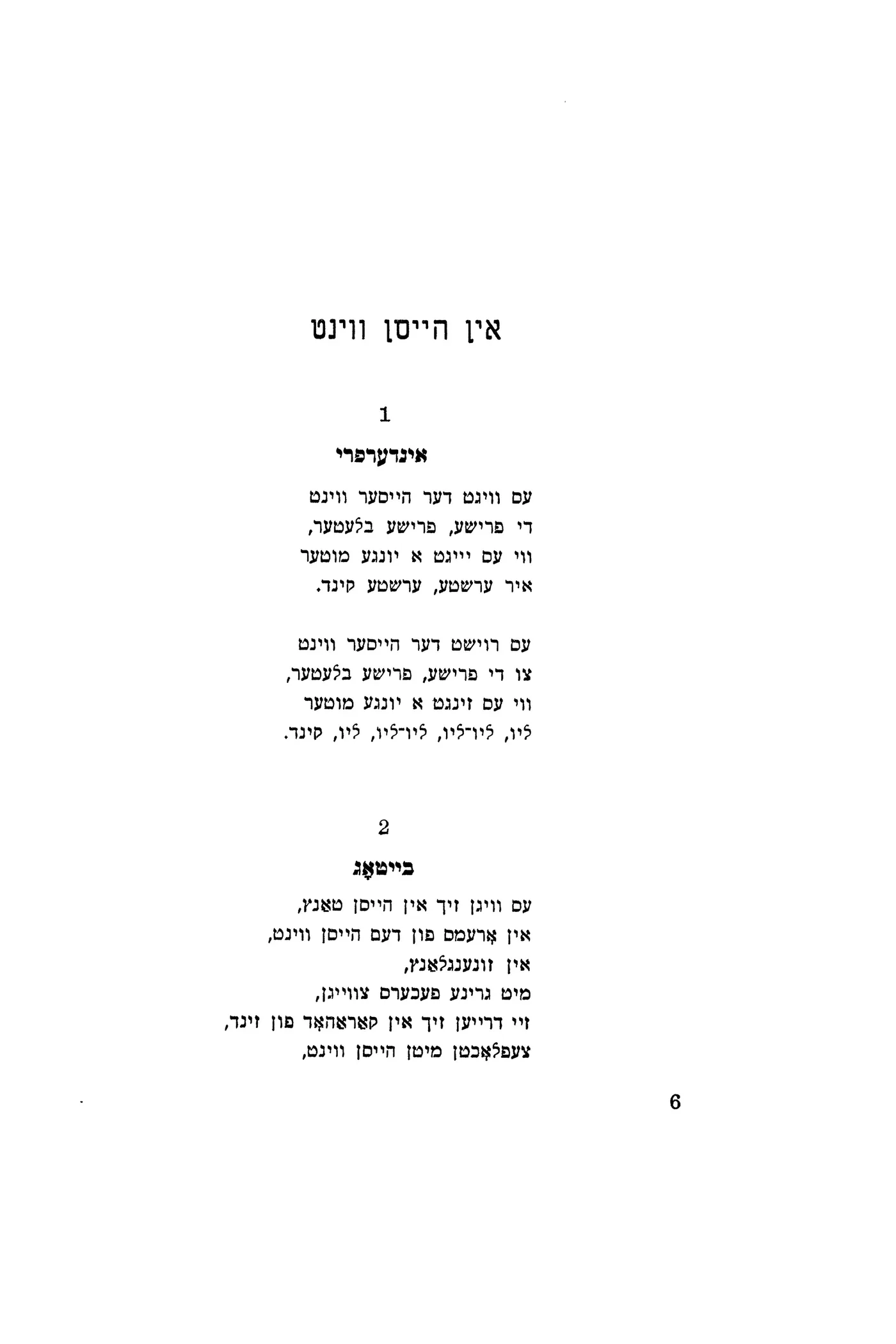
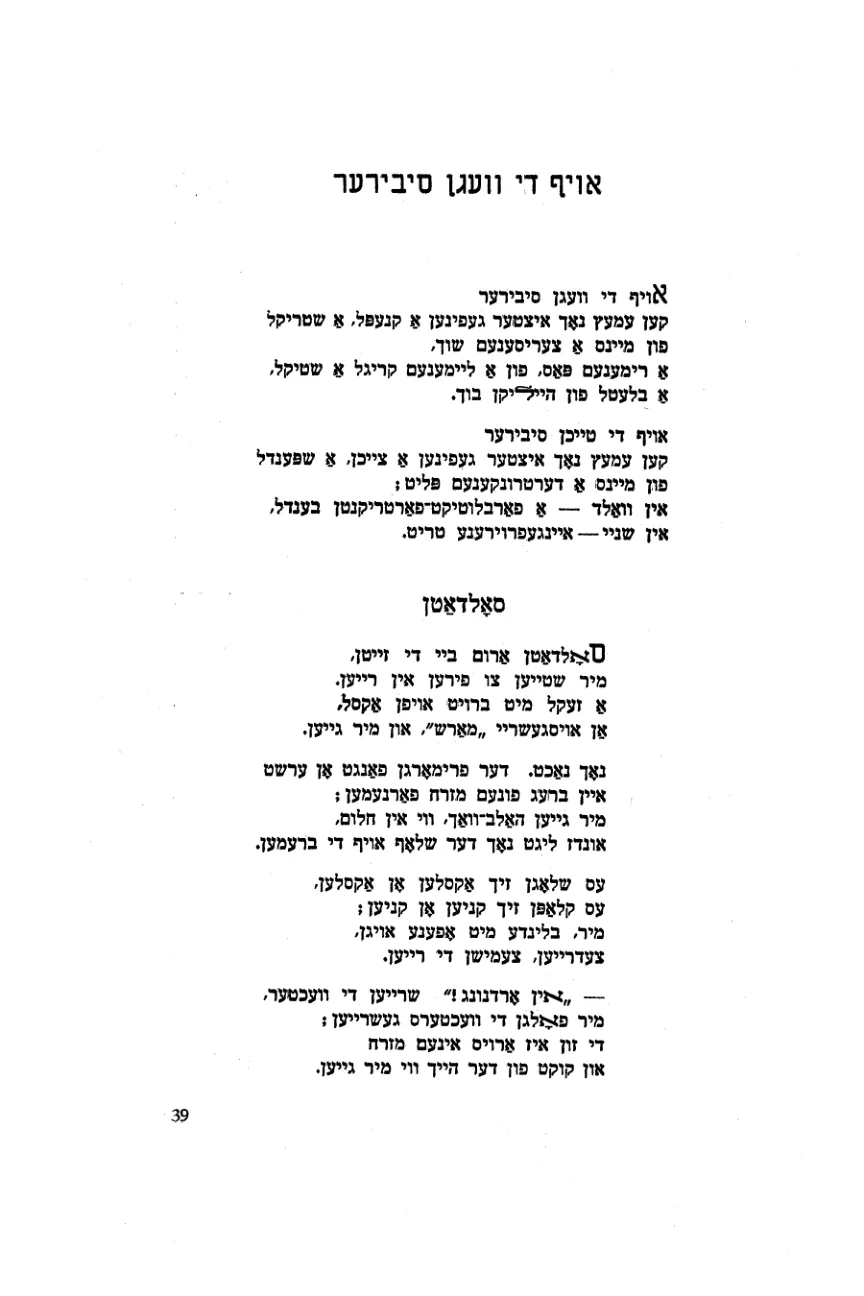
The Leivick volume arrives here the long way around: scanned pages, run through OCR, corrected and translated one page at a time. The archive shows that work in progress, and the Yiddish Library opens a search onto the Yiddish Book Center’s scanned collection at the Internet Archive, where far more is waiting than any one project could translate.
The Method

How a Poem Travels

Every work here exists in four versions. Follow a single line of Dropkin’s through each of them—and see what every step of the journey has to leave behind.

Original Yiddish · as Dropkin wrote it

איך בין אַ צירקוס דאַמע

The poem as it left the poet’s hand — in the alef-beys, read right to left. For her readers the script itself carried memory: the same letters that spell scripture here spell a circus act.

What stays behind

Nothing yet — the poem is still whole. Follow it across, and watch what each step must leave behind.

Words That Refuse the Journey

Some words never fully arrive in another language. We translate them anyway — and annotate what the translation can’t hold.

בענקשאַפֿט

benkshaft

More than “longing” — an ache for people and places that no longer exist to return to.

דווקא

davke

“Precisely so, in spite of everything” — contrariness, destiny, and a wink in a single word.

נחת

nakhes

Joy that arrives through someone else’s flourishing, usually a child’s. English needs a sentence.

Begin Your Journey

Start Exploring

Begin with Dropkin’s In the Hot Wind, the first collection here to be finished end to end—or let the archive choose for you, from either poet.

Read “In the Hot Wind”

Half-Voll Attempts · Yiddish Literature in Translation